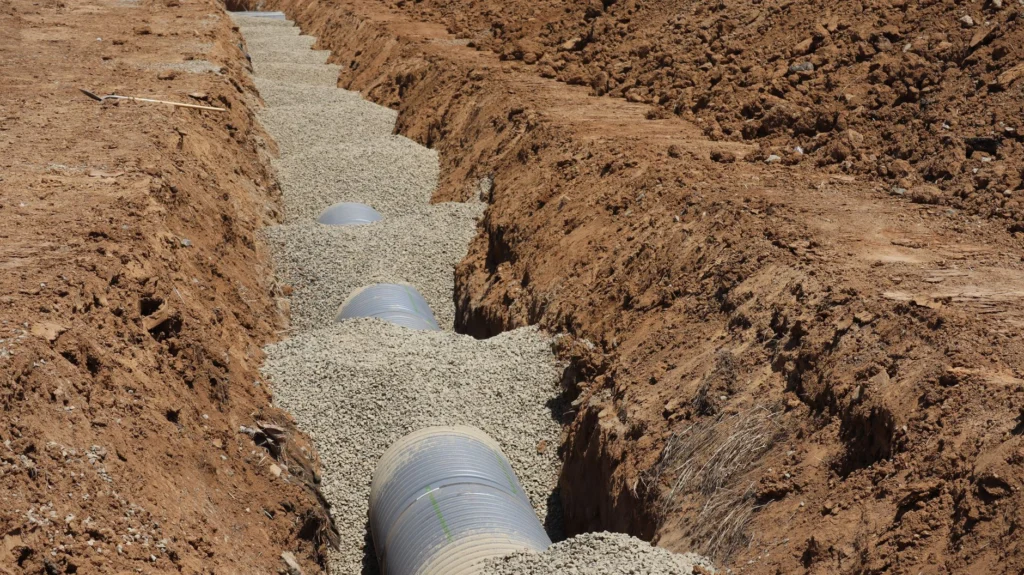
A trench five feet deep doesn’t look like a death trap. That’s exactly the problem. The walls hold for an hour, a day, a week — long enough to lull a crew into setting pipe without a box — and then a few hundred pounds of saturated soil lets go without a sound. There’s no warning, no time to climb out, and no second chance. One cubic yard of dirt can weigh as much as a car, around 3,000 pounds, according to OSHA. A worker buried to the chest can’t breathe against that weight, and a worker buried to the head usually doesn’t come out alive. Trench safety isn’t a box you check on a JHA — it’s the difference between everybody driving home and a fatality investigation on your jobsite.
The good news: cave-ins are almost entirely preventable, and the industry has proven it. The bad news: the rules are simple enough that most fatal collapses involve a crew that knew better and cut the corner anyway. This guide walks through what the numbers say, what OSHA actually requires, and how to build trench safety into the way your crews work — not just the binder they sign off on.
Trench safety by the numbers
Construction remains one of the deadliest industries in the country. In 2024, 1,034 construction workers died on the job at a rate of 9.2 deaths per 100,000 full-time-equivalent workers, according to the Bureau of Labor Statistics Census of Fatal Occupational Injuries, as reported by Construction Dive. That was down from 1,075 construction deaths in 2023, but it still works out to roughly one in five of all U.S. workplace fatalities happening on a construction site.
Trenching is a small slice of that total, but a brutal one. Trench-collapse fatalities have actually been falling: from 39 deaths in 2022 to 15 in 2023 and 12 in 2024, per national OSHA reporting cited by Equipment World — a nearly 70 percent drop in two years that OSHA credits to aggressive enforcement and outreach. But the trend is fragile. OSHA reported 11 trench-related fatalities in 2025 as of late July, and warned that a cluster of Midwest collapses was reversing the progress (OSHA). Zoom out and the toll is sobering: more than 250 workers have died in trench cave-ins since 2013, and in most of those cases the employer simply failed to follow basic protective rules, as NPR reported.
Read those numbers the right way. The decline proves cave-ins are preventable — crews that slope, shore, and shield go home. The 2025 uptick proves the gains evaporate the second a company decides a box is “too much hassle for a quick fix.”
What OSHA actually requires in a trench
The rules live in OSHA’s excavation standard, 29 CFR 1926 Subpart P (standards 1926.650, .651, and .652). You don’t need to memorize the citation, but you do need to live by the core requirements. Here’s the short version.
The 5-foot rule
Any trench five feet deep or deeper needs a protective system — sloping, benching, shoring, or shielding — unless the excavation is entirely in stable rock. That’s the line people remember. But the rule has a second half that gets people killed: a trench less than five feet deep also needs protection if a competent person spots signs of a potential cave-in. Depth is a threshold, not a free pass. Shallow trenches in wet, sandy, or previously disturbed soil have buried plenty of workers.
Slope it, shore it, or shield it
OSHA gives you three protective approaches, and the right one depends on the trench, the soil, and the work:
- Sloping or benching. Cut the trench walls back to an angle the soil can hold, or step them in benches. Cheapest when you have the room and the spoil-pile space — and useless when you’re working in a tight ROW between a curb and a building.
- Shoring. Support the walls in place with hydraulic shores, timber, or an engineered system so they can’t move. Good for tight quarters and for protecting existing structures and utilities next to the cut.
- Shielding. Drop in a trench box (shield) so that even if the wall fails, the worker inside the box is protected. The workhorse for production pipe-laying. Just remember a box protects what’s inside it — staging, climbing out, or reaching outside the box is where people still get caught.
Know your soil type
OSHA classifies soil from most to least stable: stable rock, then Type A, Type B, and Type C. The classification drives your sloping angles and what protective system you can use. Type C — running sand, gravel, soft clay, or any soil with water seeping in — is the least stable and demands the most conservative approach. And here’s the catch: soil that was Type A yesterday can become Type C after a rainstorm, after a freeze-thaw cycle, or once vibration from nearby traffic and equipment works on it. Classify the soil for the conditions you have today, not the conditions in the geotech report.
The competent person
OSHA requires a “competent person” to inspect the trench — someone with the training and authority to identify hazards and the authority to stop work and pull people out. That last part is non-negotiable. A competent person who can spot a problem but can’t shut the job down is just a witness. Inspections happen before each shift, after any rainfall, and any time conditions change.
The hazards that hide behind the cave-in
Collapse gets the headlines, but a trench is a stack of hazards. Manage all of them, not just the walls.
- Spoil pile too close. Keep excavated material and equipment at least two feet back from the edge. A pile right at the lip adds surcharge load to the wall and rains debris on whoever’s below.
- No safe way out. Trenches four feet or deeper need a ladder, ramp, or steps within 25 feet of every worker. When a wall starts to go, the time to climb out is measured in seconds — the egress has to be right there.
- Underground utilities. Call 811 and locate before you dig, every time. Striking a gas line, a fiber bundle, or an energized conductor turns a routine dig into a different kind of emergency.
- Hazardous atmospheres. Trenches deeper than four feet can collect gas, low oxygen, or fumes from nearby equipment. Test the air when an atmosphere could exist, and ventilate before anyone enters.
- Water accumulation. Standing water means the soil is losing strength and the classification is dropping. Don’t put workers in a trench with water moving in until you’ve controlled it and re-inspected.
- Mobile equipment and traffic. Spotters, barricades, and warning systems keep loaders and public traffic from rolling material — or a wheel — into the cut.
Building a trench safety culture, not just a checklist
Almost every fatal collapse has the same root cause, and it isn’t ignorance — it’s pressure. The crew knew the box was sitting on the trailer. They skipped it because the fix was “just a quick repair,” the box was a hassle to set, or the schedule was tight and the foreman didn’t want to lose 20 minutes. Trench safety lives or dies on whether your culture makes the safe choice the easy choice.
- Make protective systems non-negotiable. “No box, no body in the hole” should be a rule nobody on your crew is ever empowered to waive — not the foreman, not the super, not the owner standing on the curb.
- Give the competent person real authority. Back their stop-work calls publicly and every time. The first time you override one to keep the schedule, you’ve taught the crew the inspection is theater.
- Run a real daily inspection. Before each shift and after every rain, walk the trench, check the soil, the walls, the egress, the spoil pile, and the air. Document it. A 90-second look beats a fatality report.
- Train for the conditions, not the certificate. A competent-person card from three years ago doesn’t help if the crew can’t tell Type C soil from Type B after a storm. Refresh it and make it hands-on.
- Plan the trench before the dig. Bid and schedule the protective system, the egress, and the inspection time into the job. When safety is in the plan and the price, nobody has to “find” the time for it in the field.
Why trench safety belongs in your prequalification
If you’re a GC awarding excavation, utility, or sitework, trench safety isn’t only your sub’s problem — it’s your liability, your schedule, and your name on the project. The cheapest bid from an outfit that treats trench boxes as optional is the most expensive bid you’ll ever accept once OSHA shows up. So vet it before you award.
- Ask for the safety record. EMR, OSHA citation history, and any trenching-specific incidents — request them as part of the bid, not after the cave-in.
- Confirm the competent person. Who is it on your job, and what’s their authority to stop work? Get a name, not a policy.
- Check the equipment. Trench boxes, hydraulic shoring, and a protective plan rated for the depth and soil you actually have on site.
- Look at the written program. A real excavation safety program and inspection process, not a generic safety manual with the company name swapped in.
This is where prequalification earns its keep. Pulling safety records, certs, and trench-protection plans from every bidder is exactly the kind of legwork that drowns an estimator in email — which is why a platform like BuildBoss Bid Pro lets you collect documents, send invitations to bid, prequalify subs, and track every bidder’s status on one page. When safety documentation is part of how you take bids instead of a scramble after award, you stop choosing between a competitive number and a sub who won’t put a worker in an unprotected hole.
The bottom line
Trenches kill quietly and they kill fast, but the math on prevention is settled: slope it, shore it, or shield it, put a competent person with real authority on the edge, and never let schedule pressure put a body in an unprotected cut. The industry cut trench-collapse deaths by nearly 70 percent in two years by doing exactly that — and the 2025 uptick is a reminder of how quickly those gains slip when crews start cutting corners again. Build the protective system into your plan, your bid, and your culture, and the five-foot trench that doesn’t look dangerous never gets the chance to prove you wrong.
Sources: OSHA (trenching/excavation news releases and Subpart P, 29 CFR 1926.650–.652), U.S. Bureau of Labor Statistics Census of Fatal Occupational Injuries (2023–2024, via Construction Dive), Equipment World, and NPR. Verify current-year figures before publishing.
Ready to stop chasing bids by email? BuildBoss Bid Pro sends invitations, collects bids and keeps every trade organized in one place.
start my 14-day free trial See what general contractors get